On the UK government website, there is a press release from the Ministry of Defence dated June 18, 2026, announcing the delivery of 350 interceptor missiles, several radar systems, and 150,000 combat drones by the end of the year. This figure has since been increased to 170,000. https://www.gov.uk/government/news/750-million-package-to-provide-ukraine-with-150000-drones-and-boost-air-defence
Contrary to the Ministry's commentary, the profile of this supply package is hardly suited to improving the “protection of innocent Ukrainian people.” Instead, it vehemently pushes forward a project that CDU Bundestag member Roderich Kiesewetter had already advocated in 2024, namely “taking the war to Russia.”
Great Britain's government is once again leading the group of supplier countries distinguishing themselves with weapon systems that are increasingly effective and penetrate ever deeper into Russian territory, as previously demonstrated with cruise missiles and radioactive DU (depleted uranium) munitions.
The massive damage to oil industry facilities and the seizure of Russian tankers in recent weeks have already brought the red line disturbingly closer, placing the Russian government before a hard decision. This danger is drastically exacerbated by recent EU steps against Russia's ice-breaking LNG transport fleet. https://www.wiwo.de/unternehmen/industrie/fayard-werft-daenemarks-reichste-familie-haelt-putins-lng-flotte-in-schuss/100236588.html?utm_source
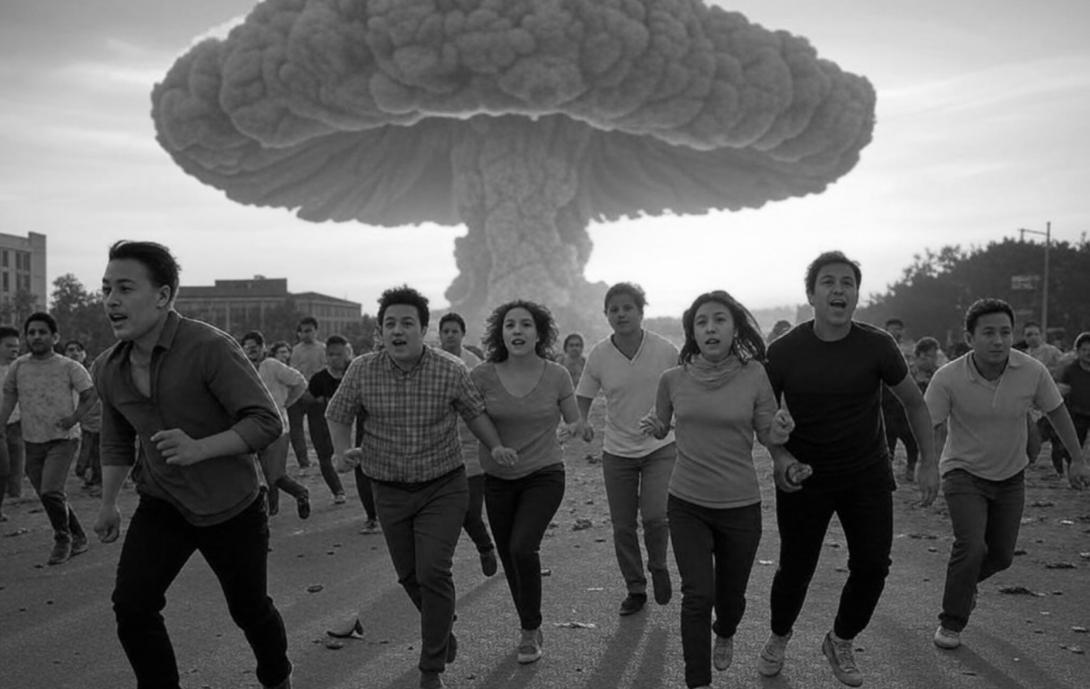
Donald Trump, the only Western politician with the necessary leverage to move the Western alliance toward correcting this suicidal course in time, has lost massive authority following the largely failed military mission in Iran. By exploiting this period of weakness of the US President for a final surge of escalation against Russia, militarists demonstrate either appalling naivety or cold irresponsibility. Even if politicians and the media persistently play down the danger, the assumption that the world's strongest nuclear power will permanently tolerate the attrition of its infrastructure, economic base, and military capacity in a conventional war against a numerically superior Western alliance can be considered detached from reality. A detailed analysis of the various psychological mechanisms involved confirms the probability of a nuclear option. https://www.frieden-freiheit-fairness.com/en/blog/psychology-supposedly-limited-nuclear-war
By contrast, the opposition of moral ally China to the use of nuclear weapons is irrelevant, as Beijing cannot act otherwise for diplomatic reasons and will under no circumstances intervene to help.
If European politicians now lead their citizens blindly or irresponsibly into such an elementary danger, this can be identified as a repetition and escalation of unaddressed historical missteps in a long chain of disastrous military interventions from Vietnam to Afghanistan. The errors lay primarily at the psychological level. Among other things, the population was driven into the arms of the militarily fought militias through brutal interrogations, humiliations, and the destruction of their property, while a corrupt clique gained access to power instead of democratic idealists.
Such reprehensible and counterproductive practices would have been put to an end had there been an undisturbed flow of information. But since 1899 at the latest (the beginning of the Philippine–American War), the US military and intelligence services have shielded themselves from critical scrutiny—always in the name of national security.
An AI assessment stated: “It was the US military and the CIA that completely cut off physical and informational access to the fatal developments at the source. — Facing them were major private media outlets and news agencies that largely adopted and multiplied official, sugarcoated narratives from Washington without verification.”
The trail of chaos left worldwide by a Western (in)security apparatus lacking adequate democratic control is now logically continuing within its own cultural sphere.
It is the same sugarcoated reporting by the military and mainstream media as during past counterproductive military operations that enables militarists in the MIC and NATO to continue escalating without major public resistance. On the Gov.UK homepage, regarding the delivery of 170,000 drones by the end of the year (over 900 per day), it states: “The UK is putting pressure on Putin to negotiate.” That is either blind to reality or cynical. It was then-British Prime Minister Boris Johnson who blocked the agreement ready for signature in March 2022, and it is the Ukrainian leadership that broke off negotiations on May 17, 2022, and has avoided them ever since with unrealistic preconditions.
Before discussing the threat situation, one fact remains to be set straight: Even if the media or the British Ministry of Defence repeat the phrase “unprovoked Russian war of aggression” like a mantra on the government homepage, this one-sided assessment does not withstand fair analysis of the backstory. The millionfold repetition reveals instead the fragility of a dogma that can only be sustained through such money-backed propaganda tools. For an objective discourse—which is shunned here—highlights the numerous and in part massive provocations by Western militarists from 1999 to February 2022, without downplaying Russian legal violations. https://www.mearsheimer.com/wp-content/uploads/2019/06/Why-the-Ukraine-Crisis-Is.pdf
Sergey Karaganov is a Russian hardliner, or more precisely, a political intellectual who underwent a profound transformation after bitter experiences over the past 30 years—from a friend of Europe to someone who views this continent with rejection. As honorary chairman of the Council on Foreign and Defence Policy and an informal government advisor, Karaganov exerts far-reaching influence even without holding political office. American journalist Tucker Carlson conducted an interview with him in January 2026 that every European should listen to or read as a transcript in order to wake up. https://podcasts.happyscribe.com/the-tucker-carlson-show/breaking-news-russia-will-nuke-germany-the-uk-if-ukraine-war-continues-warns-top-putin-advisor
“If Russia comes ever close to a defeat, that would mean that Russia now would use nuclear weapons and … Europe will be finished physically.” Karaganov geographically narrows down this very drastic perspective elsewhere. His choice would fall on Great Britain and even more so on Germany. The obvious exposure of the United Kingdom represents a complex topic. https://www.frieden-freiheit-fairness.com/en/blog/united-kingdom-road-sacrifice
For Germany, on the other hand, there are clear reasons for top placement among targets for a nuclear warning strike. “When a Chancellor … of Germany is talking about recreating … Bundeswehr, to be the strongest army in Europe… That means that he dooms his country for elimination.”
This assessment is reminiscent of the naval expansion of the German Emperor prior to World War I, which was perceived in Great Britain as a disregard for the hierarchy on the high seas.
Germany's current situation, however, is significantly less favorable. Russia can at any time declare a breach of the armistice of May 8, 1945, force a renewed surrender, and thereby isolate Germany from its allies. The American nuclear weapons stored here represent primarily a hazard to the German population as strategic targets for preemptive strikes, while largely failing in their deterrent effect. Realistically, Karaganov assumes that the US would generally not intervene in the event of a Russian nuclear strike in Europe. This applies all the more if the strike were to hit only a single country, such as Great Britain or Germany. Fortunately, the relevant Article 5 of the NATO Treaty is sufficiently vague that such a nuclear warning strike would by no means automatically lead to a major nuclear war. In any case, a drastic clarification of the military hierarchy would make it clear to naive politicians in Europe that they have not only lost sight of their responsibility for the lives of the 'defended' (but never consulted) people in the contested areas and in their own countries, but also lost respect for the adversary.
The clock is now at almost midnight to take seriously the insight proclaimed by Mahatma Gandhi and Martin Luther King that stable peace requires an understanding of the (real or perceived) enemy. Understanding, particularly of motives, is in turn the precondition for the timely emergence of mutual respect—in time to establish stability through dialogue. Conversely, a lack of respect destabilizes until it is forced in a test of strength.
Above all, the EU Commission as well as the politicians of Great Britain and Germany are in the process of cornering their opponent Russia until it demands the missing respect by means of a drastic warning strike. Respect is subsequently the decisive braking factor preventing the unleashing of full nuclear destructive potential.
This text is licensed under the Creative Commons Attribution 4.0 International License (CC BY 4.0). It may be shared, translated, and redistributed free of charge, provided that my name and my website are linked as the source. Christian Hamann https://www.frieden-freiheit-fairness.com/en